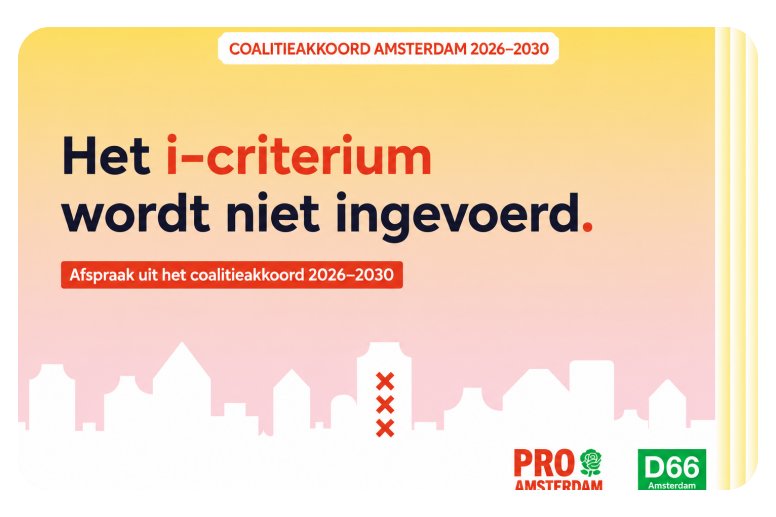
The i-criterion was not implemented in Amsterdam's 2026 coalition agreement. Years of legal, political and public efforts — including research by Ipsos I&O, formal intervention in civil proceedings and cooperation with Wallen (Red Light District) entrepreneurs — made a substantial contribution to this.
At the end of 2022, the introduction of the i-criterion was concretely on the table in Amsterdam. At the mayor's request, the association then proposed alternatives to limit the 'pulling effect' of coffeeshops, substantiated by additional research that tested and refuted assumptions from earlier OIS reports. The proposal ultimately did not reach the council and was not included in the vision for the visitor economy — but the issue never truly disappeared.
In 2025, the discussion flared up again. Stichting Amsterdam heeft een Keuze (Amsterdam has a Choice Foundation) tried to enforce, through civil proceedings, that the municipality take measures based on the Verordening Toerisme in Balans (Tourism in Balance By-law), with the i-criterion explicitly mentioned as an option. A policy discussion was thus deliberately conducted through civil law.
Subsequently, Amsterdam's 2026 coalition agreement stipulated that the i-criterion would NOT be introduced. Ipsos research substantiated the expected loss of turnover in the city centre, and Wallen entrepreneurs publicly spoke out against its introduction. The issue remains on the radar — particularly due to enforcement and the possible shift to street dealing elsewhere.