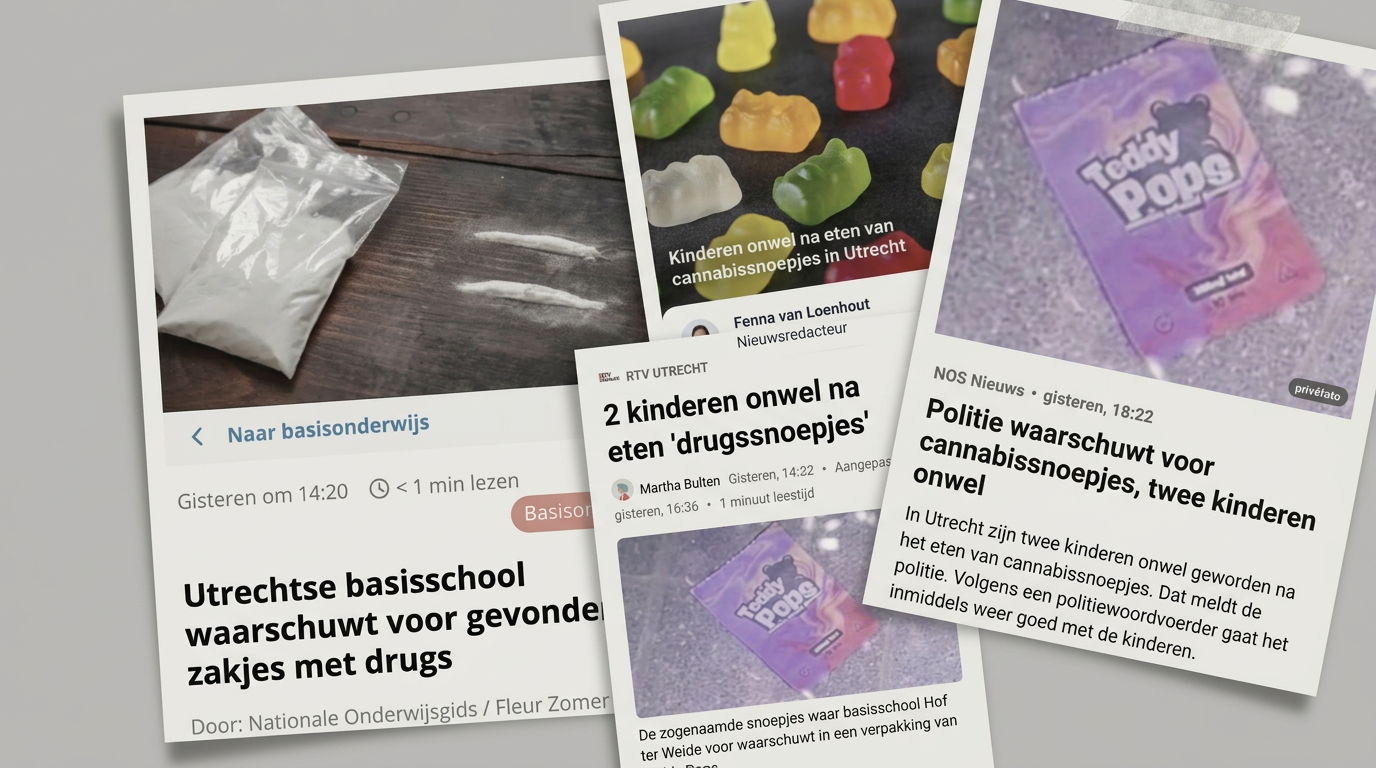
In Utrecht, bags of so-called Teddy Pops were found, and two children fell ill. RTV Utrecht reported on 'drug sweets', while NU.nl referred to them as 'cannabis sweets' and 'THC' — without the police having confirmed this. NOS then adopted this characterisation.
First and foremost, my sympathy goes out to the children who fell ill and to their parents. What exactly happened must be thoroughly investigated. Children should never come into contact with products that resemble sweets but may contain psychoactive substances. This is serious, regardless of the substance ultimately involved.
When I read the NU.nl article, something immediately struck me. First, there was talk of cannabis sweets and THC. A little later, it stated that the found bags were allegedly from a smartshop. This combination in particular raised questions, as THC products are not permitted to be sold there. The article referred to earlier reporting by RTV Utrecht. There, it appeared to have been formulated differently still.
What is actually known?
According to reports, bags of so-called Teddy Pops were found near primary school KBS Hof ter Weide and in other places in the Terwijde district of Utrecht. Schools warned parents with the message that these were products that looked like sweets but were said to contain drugs.
Two children also fell ill. According to a police spokesperson, they are now doing well. The police conducted a neighbourhood investigation, but this has yielded little so far.
RTV Utrecht reports on 'drug sweets'
RTV Utrecht published the report under the headline:
“2 children ill after eating 'drug sweets'”
This describes the product as a 'drug sweet', but not yet as a cannabis or THC product. The reporting does not indicate which substance it was supposedly.
The term aligns with the school's warning, which stated:
“Those look like sweets, but they are drugs.”
That is a clear warning to parents, but not yet a confirmation that it involves cannabis or THC.
NU.nl turns them into cannabis sweets
NU.nl goes a clear step further in its reporting and is the first to cover the incident under the headline:
“Children ill after eating cannabis sweets in Utrecht”
The opening sentence then presents it as a fact that two children fell ill “after eating cannabis sweets”. NU.nl writes that the police reported this.
A few paragraphs later, however, it states that the police do not yet know if the children ate the found Teddy Pops. These statements are difficult to reconcile. You cannot first report it as a confirmed fact that children fell ill from cannabis sweets and then write that it is unknown whether they even ate the found sweets.
In addition, a general explanation about THC is added. The reader is told that THC is the main active substance in cannabis, that the substance falls under the Opiumwet (Opium Act), and that the effect of edible THC can start later and last longer.
This structure inevitably creates the impression that the discovered Teddy Pops contained THC. But nowhere in the article does it appear that the police confirmed this.
Moreover, a stock photo of Haribo-like gummy bears was used, whereas in this case, it concerned bags of Teddy Pops. This creates a strong association with cannabis, not only textually but also visually.
Furthermore, this characterisation was not limited to NU.nl. NOS also picked up the report under the headline “Police warn about cannabis sweets, two children ill” and thereby repeated the link to THC.
This is striking. Less than a year ago, a similar situation arose concerning Haribo sweets. Even then, cannabis was quickly named as the explanation. Later, research by the Nederlands Forensisch Instituut (NFI) (Dutch Forensic Institute) showed that no cannabis or related substances had been found in the examined Haribo sweets (AD). Precisely for this reason, restraint is important as long as it has not been determined which substance was actually found in a product.
Cannabis sweets from a smartshop?
Both NU.nl and NOS also write that the found Teddy Pops were supposedly from a smartshop. This statement in particular immediately raises the question of whether it really involved cannabis or THC.
THC sweets are not allowed to be sold in a Dutch smartshop. The link between a smartshop and THC is therefore far from obvious. Nevertheless, the national media present the incident as a story about cannabis sweets and then add an explanation about THC.
In RTV Utrecht's reporting, there is talk of 'drug sweets'. The school warns that it concerns sweets that are said to contain drugs. According to the articles, the police say that the bags came from a smartshop and that it has not yet been established whether the children ate these specific Teddy Pops.
However, nowhere does it appear that the police confirmed it was cannabis or THC.
That step seems to have been taken by NU.nl. NU.nl changes 'drug sweets' to 'cannabis sweets' and then adds an explanation about THC. NOS then adopts this characterisation shortly after. This creates a much more specific story than what follows from the original information.
Lack of knowledge changes the story
A product from a smartshop is usually precisely not a cannabis product. THC products are not allowed to be sold there.
Nevertheless, the reporting changes from 'drug sweets' at RTV Utrecht to 'cannabis sweets' at NU.nl. Subsequently, NOS also adopts this characterisation.
Thus, an assumption quickly becomes a widely circulated conclusion.
Warning is justified, filling in is not
The fact that children may have found psychoactive sweets and fallen ill must be taken very seriously. The warning not to pick up food from the street is, of course, justified.
Based on the published information, it does not appear that the police identified the found Teddy Pops as a cannabis or THC product. Yet, national media present cannabis and THC as the explanatory framework for the incident.
Journalism can be expected to check facts and not simply fill in missing information. Especially from news organisations with the authority and reach of NOS and NU.nl.
Otherwise, a warning about unknown 'drug sweets' turns into a cannabis story for which the substantiation is missing in the published reporting.
Update: NU.nl has stated that the police confirmed to its editorial staff that the sweets contained cannabis. Because questions remain about the Teddy Pops, the alleged sale via a smartshop, and the basis of that confirmation, I have asked the police for further clarification.
Update: The police informed me by phone that they cannot confirm that the children fell ill after eating sweets with cannabis. However, empty packages of sweets possibly containing THC were found, but this does not confirm what the children actually ate. It is therefore striking that NU.nl writes that the police confirmed to the editorial staff that the sweets the children ate were cannabis sweets.
Sources
- NOS, “Police warn about cannabis sweets, two children ill”, https://nos.nl/artikel/2623114-politie-waarschuwt-voor-cannabissnoepjes-twee-kinderen-onwel ↑
- RTV Utrecht, “2 children ill after eating 'drug sweets'”, https://www.rtvutrecht.nl/nieuws/4070962/2-kinderen-onwel-na-eten-drugssnoepjes ↑
- NU.nl, “Children ill after eating cannabis sweets in Utrecht”, [URL to be added] ↑
- Nationale Onderwijsgids (National Education Guide), “Utrecht primary school warns about found bags with drugs”, https://www.nationaleonderwijsgids.nl/basisonderwijs/utrechtse-basisschool-waarschuwt-voor-gevonden-zakjes-met-drugs/ ↑
- NOS, “No cannabis found in Haribo sweets, NFI reports”, https://nos.nl/artikel/2571630-geen-cannabis-gevonden-in-snoepjes-van-haribo-meldt-nfi ↑
— Simone van Breda, 16 July 2026
Preferred source
Follow Simone van Breda on Google
Choose Simone van Breda as a preferred source and see my news and analyses more often in relevant searches.